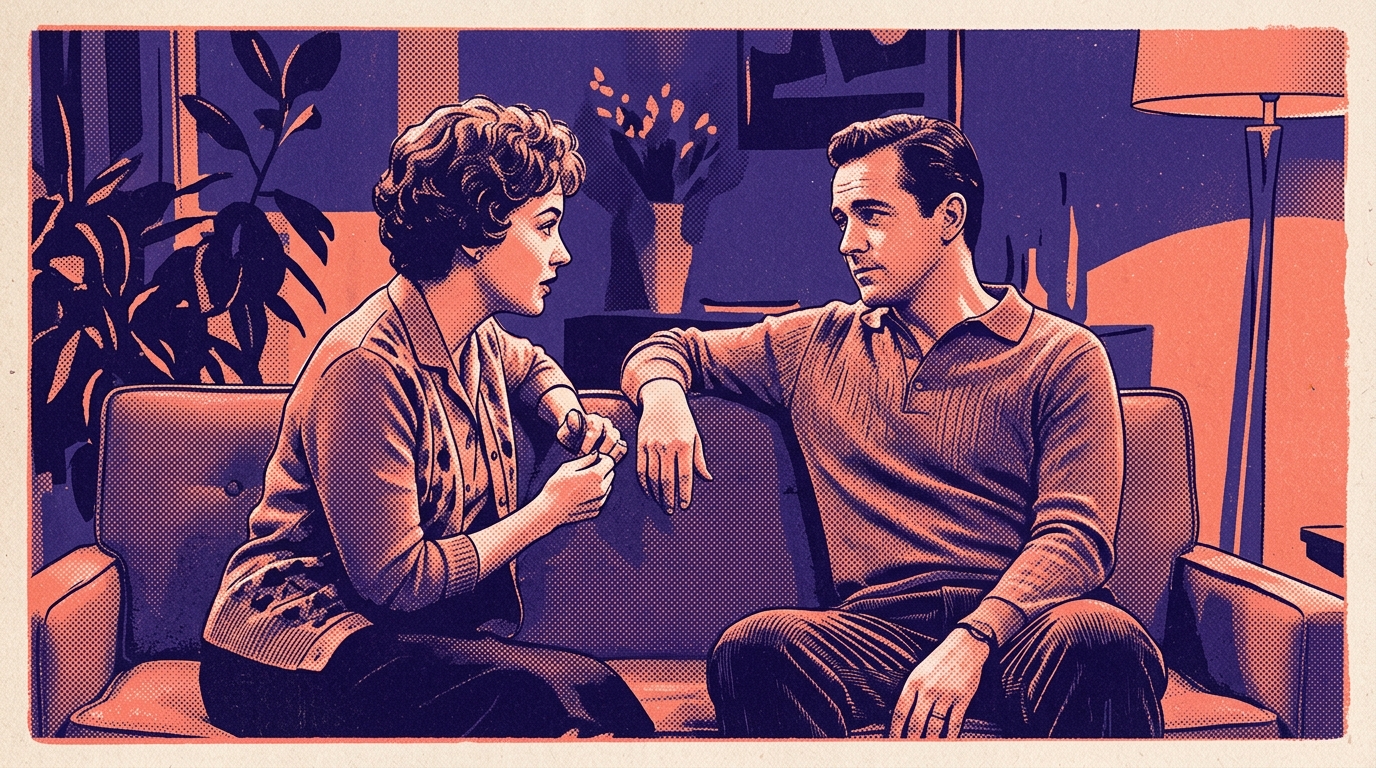
What synastry is, in plain English
Synastry is the technique of comparing two birth charts to see how they interact. That's it. No mystery, no ancient secret handshake — you take one person's planetary placements, lay them next to another person's, and look at the angles between them. Astrologers have used this method for centuries to talk about marriages, business partnerships, and family dynamics, long before it became a feature in a dating app quiz.
Here's the distinction that matters: your natal chart is a solo portrait. It shows your Moon, your Mars, your Saturn, all relative to the moment and place you were born. Synastry takes two of those portraits and asks a different question — not "who are you," but "what happens when your chart meets theirs." Your Venus might sit right on top of their Mars. Your Moon might form a tense angle to their Saturn. Those contacts are the actual content of a synastry chart — not a vibe, not a percentage, but a specific set of geometric relationships between two real sets of planetary data.
The angles themselves have names. A conjunction is two planets sitting close together. A square is planets at roughly a 90-degree angle, which reads as tension. A trine is planets at roughly 120 degrees, which reads as ease. None of these are inherently good or bad — a trine can mean comfort that curdles into complacency, and a square can mean the friction that makes two people actually grow. That nuance is exactly what gets lost when synastry gets reduced to a single number, which is the whole subject of the next section.
Why compatibility scores are useless
Type "synastry" into any search bar and you'll get a wall of calculators promising a compatibility percentage — 87% match, 42% match, some tidy number that feels like a grade on a test you didn't study for. The problem isn't that these tools are lying exactly. It's that they're answering a question astrologers don't actually ask.
Real synastry doesn't produce a score, because compatibility isn't one thing. A couple can have a gorgeous, easy Venus-to-Venus connection — shared taste, shared affection, everything feels natural — and still struggle if their Saturn contacts create constant pressure around commitment or control. Averaging those into one number tells you nothing useful. It's like grading a car on a single "goodness" score instead of telling you separately about the engine, the brakes, and the legroom.
There's also a deeper misconception baked into the score obsession: the idea that synastry should tell you whether you'll end up together at all. On r/astrology, this comes up constantly — people asking whether a synastry chart can tell you if you're going to be with someone, or if you should be. That's not what the chart does, and no astrologer worth listening to will tell you otherwise. A chart comparison shows you the mechanics of a dynamic — where the ease is, where the friction is, what each of you tends to need from the other. It doesn't cast a verdict on outcome, because outcome depends on two people making choices, not on planetary math.
What actually matters is specificity: which planet, which aspect, which house. A score can't hold that. A paragraph can.
The placements astrologers check first
When you actually sit down with two charts, you're not scanning for a general impression — you're checking specific contacts in a specific order, because some planetary pairs carry more weight than others.
Moon-to-Moon: emotional wiring
The Moon governs emotional needs — how you self-soothe, what makes you feel safe. When comparing two charts, the Moon-to-Moon aspect is often the first thing worth checking, because it tells you whether two people process feelings on compatible frequencies. A trine between Moons (an easy 120-degree angle) usually means you understand each other's emotional logic without translation. A square between Moons means you might need very different things when upset — one of you wants space, the other wants closeness — and neither instinct is wrong, just mismatched in timing.
Venus-to-Mars: attraction dynamics
Venus is what you're drawn to; Mars is how you pursue and assert. A Venus-to-Mars contact between two charts is the classic chemistry indicator — it's often present in relationships with strong physical pull. A conjunction here (planets sitting close together) can feel like instant magnetism. A square can feel like friction that reads as attraction precisely because it's charged. This is also the pairing that explains a lot of "why did I want someone who was clearly wrong for me" moments — strong Venus-Mars contact creates desire, not necessarily compatibility.
Saturn contacts: glue or grind
Saturn represents structure, responsibility, and time. When one person's Saturn touches another's personal planets — Sun, Moon, Venus — it tends to create a feeling of weight and seriousness. This is genuinely double-edged. Saturn contacts often show up in long, committed relationships, because Saturn is the planet of staying. But the same contact can feel like restriction if the dynamic isn't handled consciously — like one person is always the responsible adult and the other is always managed.
Here's a worked example, built as a representative case rather than any real person's chart: imagine your Moon in Cancer falling in exact square to your partner's Saturn in Libra. In practice, this often plays out as you needing frequent verbal reassurance and physical closeness to feel emotionally secure, while your partner instinctively responds to closeness with a bit of distance and formality — not because they don't care, but because Saturn's instinct is to manage feeling through structure and control rather than through open expression. Left unexamined, you might read their reserve as rejection, and they might read your need for reassurance as excessive. Named and understood, it becomes a workable pattern: you learn that their steadiness is their form of commitment, and they learn that a few extra words of warmth cost them nothing and mean everything to you. Same aspect, two very different lived experiences, depending entirely on what the two people do with it.
The red flags that aren't — and the green flags nobody mentions
The instinct when reading synastry is to hunt for squares and call them warnings, then hunt for trines and call them blessings. That instinct is mostly wrong, and it's worth retiring.
A hard aspect — a square, an opposition — between two charts is not a red flag. It's information about where effort will be required. Some of the most enduring relationships have a difficult Saturn-to-Sun contact or a tense Mars-to-Mars square, because friction, over time, is often what builds respect and staying power. Couples with only easy aspects between them sometimes report the relationship feeling pleasant but weirdly low-stakes — comfortable in a way that never quite deepens, because nothing ever asked anything of either person.
Meanwhile, the quietly important placements rarely get mentioned in the compatibility-score version of synastry. Mercury-to-Mercury contacts, for instance — how you each think and communicate — predict day-to-day ease far better than a flashy Venus-Mars pull does. A steady Mercury connection means you can actually talk through the hard stuff the Saturn contact brings up. Chiron contacts between charts, where one person's placement touches another's old wound, can also matter enormously; if this pattern feels familiar, it's worth reading about Chiron in the birth chart directly, since it explains why certain people seem to press on the same bruise repeatedly.
The honest framing: synastry is a map of tendencies, not a verdict. It shows you where the work is, where the ease is, and where you'll need to actually communicate instead of assuming the chart will do the relationship for you. It doesn't tell you the ending. It tells you the terrain.
Beyond romance: comparing your chart with a friend's, parent's, or child's
Synastry gets marketed almost entirely as a romance tool, which sells the technique short. The same comparison method works for any relationship, though what you're looking for shifts.
With a close friend, Venus-to-Venus and Moon-to-Moon contacts still matter, but Mercury contacts often carry more weight than they do romantically — friendships live and die on whether you can actually talk to each other, argue without it becoming a crisis, and enjoy the same kind of conversation. A friendship with strong Mercury synastry tends to feel effortless in exactly the way that "we can talk for six hours and it's still not enough" describes.
With a parent, Saturn contacts take center stage differently than they do in romance — a parent's Saturn touching a child's Sun or Moon often describes the shape of authority and expectation in that relationship, for better or worse. This is where a children's horoscope comparison — reading a child's chart against a parent's — gets genuinely useful, not as a way of predicting who your kid will become, but as a way of noticing where your instincts as a parent might clash with their actual temperament. If your Moon is in a grounded earth sign and your child's Moon is in a restless air sign, knowing that early can save both of you a lot of unnecessary conflict over what "calm" is even supposed to look like.
With a parent-child pair in the other direction — comparing your own chart against a parent's — the same Saturn and Moon contacts explain a lot about old dynamics you're still unpacking as an adult. It's less about compatibility and more about pattern recognition: seeing, in planetary terms, why a certain interaction always went a certain way.
Start with your own chart before you compare it to anyone's
None of this works if you don't know your own placements first. Synastry only tells you something useful when you already understand what your Moon, your Venus, your Mars, and your Saturn are doing on their own — otherwise you're comparing a chart you understand to one you don't, and drawing conclusions from half the picture.
This matters more than it sounds. If you don't know that your Moon is in a sign that needs a lot of verbal reassurance, you might misread a partner's quiet, steady Saturn energy as coldness, when the actual issue is a mismatch you haven't named yet. If you don't know your own Venus placement, you might mistake intensity for compatibility every single time, because you don't recognize your own attraction patterns clearly enough to see when they're leading you somewhere familiar rather than somewhere good.
Your birth chart isn't static context, either — the placements in it interact with what's happening in the sky right now, which is a separate layer worth understanding once you've got your own chart down; transits explain why the same natal Saturn placement can feel completely different at 25 than it does at 35. And if you've ever generated a chart online and stared at a wheel of symbols with no idea what you were looking at, it's worth knowing that accuracy here depends on details people often guess at rather than check — worth sorting out before you try to layer a second person's chart on top of your own.
Once you actually know your own placements — not just your sun sign, but your Moon, Venus, Mars, and Saturn — synastry stops being a party trick and starts being useful. You can look at what your own chart reveals about your relationship style and then, only then, start laying someone else's chart next to it and reading the actual mechanics instead of waiting for a percentage to tell you what to feel.